Showing posts with label Travel. Show all posts

Saturday, May 31, 2014

I can't talk about Israel before I talk about HONDURAS

I'm currently in Israel, but I can't discuss this adventure until I talk about my trip to Honduras:

In March, I traveled to Honduras.  That was months ago, I know.  Still, I'm going to give it a blog post.

I went to Honduras with Public Health Brigades, a branch of Global Brigades.  We were stationed in El Ojochal, a rural village in the coastal Valle region, which is wedged between El Salvador and Nicaragua.

I expected heat.  Mugginess.  I'd been taking malaria medicine, and I'd stocked up on unscented soap so as not to attract swarms of mosquitos that could potentially carry malaria or dengue fever.  I expected dirt.  Grime.  To be escorted through the airport by armed guards.  (Tegucigalpa has one of the highest homicide rates in the world).

I wasn't prepared for this:


This is the interior of one of the homes we were working on.  It was a two room hut with dirt floors and large gaps in the walls, which allowed the chickens to enter and exit as they pleased.  The first picture shows a stove in the corner of the kitchen.  As part of our project, we built a brick stove with a chimney to help prevent respiratory problems.  It also requires less wood.  The second photo shows the sleeping area.  This family slept in hammocks, as did most families in El Ojochal.


Here we see the exterior of a typical home (at least, typical for the area in which we were working).  These photos are from Amapala.

I knew that Honduras was not a wealthy country by any means.  Still, I was struck by the abject poverty I saw all around me.  Everywhere I looked, I saw a decrepit hut, a malnourished child, a pile of trash littering the landscape.  It was bad.

At the same time, I was struck by the way life goes on.  I met some amazing people who were eager to share their culture with me.  We bonded over traditional Honduran folk music, food, and breathtaking vistas.


It's important to visit places like Honduras, which serve as reminders that there are severe problems in the world.  However, too often these places are seen for their problems alone.  Yes, the people I met wanted me to take and share photos so that others could see their harsh realities, but when we talked, they wanted to tell me about the beauty of their country.  It's important to remember that, too.

Thursday, June 27, 2013

Where in the World Have I Been?

Spain, Italy, Morocco, Switzerland, Turkey, Ireland, the U.K., France, Greece.  Lots and lots of places.

After about six months of being abroad, my plane touched down in Philadelphia on Wednesday afternoon.

It's like that feeling you get right after you finish a wonderful book:  you set it on your lap and stare blankly at the cover, letting it all sink in.  The characters, the setting, the plot.  The end.  You can't really do anything.  You simply sit there, thinking.

My time abroad was without a doubt the greatest experience of my life.  A story, most definitely, filled with humor, suspense, a touch of romance, and a whole lot of adventure.

One day I will write about it.  Short stories, poems, maybe a novel.  My writer's notebook is filled with ideas collected from this place and that, and someday, I'll give them definition.  For now, though, I'm still in a daze.

It's going to take me awhile to recover.

Monday, June 3, 2013

#3 Stop on the London Book Lover's Tour: The Globe

"Ay, thou poor ghost, whiles memory holds a seat
In this distracted globe.  Remember thee!"

If you guessed Hamlet, you guessed correctly.  In these lines, while "globe" means "head," it's a play on words:  it also refers to Shakespeare's famous theater, the Globe, constructed in 1599.

Though the one you'll find in Bankside was constructed in 1997.


Unfortunately, the original burnt down in 1613, due to a cannon that set fire to the thatched roof during a performance of Henry VIII.  It was rebuilt, but again, it didn't last long:  it was torn down in 1644, during the English Civil War, by the Puritans who believed theater was the art of the devil.

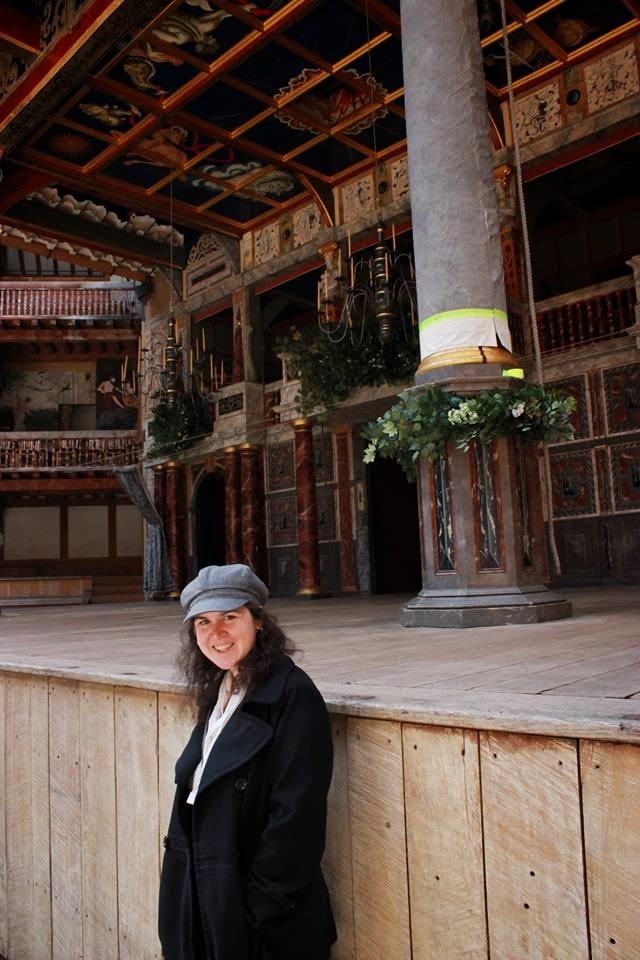
The outside of Shakespeare's Globe.  The roof is open, but it doesn't matter:  rain or shine, the show must go on!
But the fact that this is the third Globe doesn't make it any less awesome.  It's constructed to look identical to the original (admittedly, much of it is guesswork), so the overall effect is a gorgeous outdoor Elizabethan theater that continues to put on spectacular--and I mean spectacular--shows for a very affordable price.

The stage!  This is the set for A Midsummer Night's Dream.
Before you jump into a show, however, I recommend taking the tour.  The guides are all actors at the Globe, so you know you're in for a show.  They're entertaining, of course, but they're also extremely knowledgeable about Shakespeare and the history of the Globe.

For fifteen pounds, you can sit.  For five, you can stand in the yard.
I was lucky enough to see The Tempest, starring Colin Morgan (Merlin) and Roger Allam (V for Vendetta, Les Miserables 25th Anniversary Concert).  For five pounds, I got to stand in the yard as a "penny groundling."  Sure, I had to stand the whole time, and occasionally I got rained on, but that didn't matter.  The view was great.  I was right up against the stage, and since it is Elizabethan theater, there was no shortage of actor-audience interaction.  As in, the person next to me got water dumped on his head.

(Note:  The following photos are not my own, since we were forbidden from taking photos during the performance.)
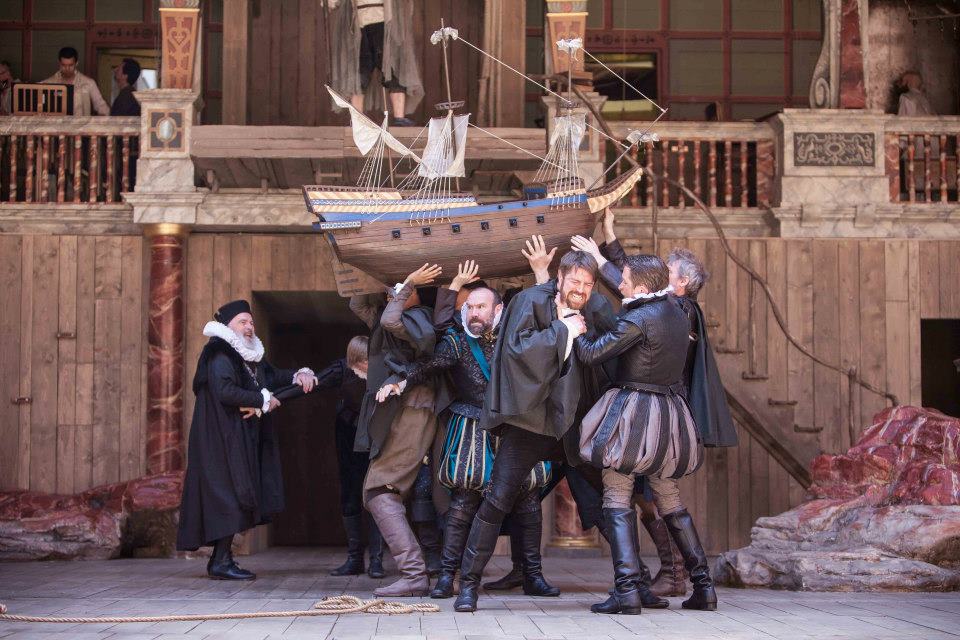
The opening scene of The Tempest.   That boat came through the audience.  Check out their costumes!
And did I mention that the show was phenomenal?  As I said, the Globe puts on spectacular plays, and it always has several to choose from.  This season, I picked from The Tempest, A Midsummer Night's Dream, MacBeth, and so many others, not all of them Shakespeare and not all of them performed in English.
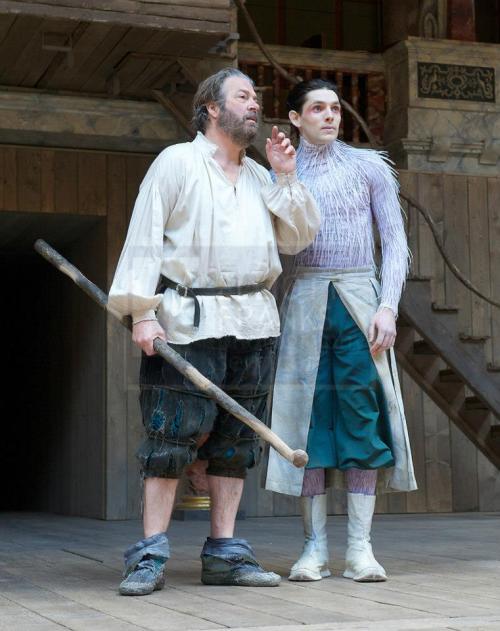
Prospero (Roger Allam) and Ariel (Colin Morgan) in The Tempest.
Even if you aren't Shakespeare's biggest fan, seeing a show here is all kinds of worth it.  To go to a true Elizabethan theater is a unique experience.  Highly recommend!

Miranda (Jessie Buckley), Prospero (Roger Allam) and Ferdinand (Joshua James) in The Tempest.


Friday, May 31, 2013

#2 Stop on the London Book Lover's Tour: King's Cross and WB Studios

"It's the same every year, packed with muggles of course."

Mrs. Weasley doesn't exaggerate when she makes that comment about King's Cross Station in Harry Potter and the Sorcerer's Stone (or Harry Potter and the Philosopher's Stone, as they call it here in the UK) by J.K. Rowling.  It's packed, especially around the entrance to Platform 9 3/4, where muggles wait in a long line for a chance at running through the barrier.  (Not really, as they have people working there, probably to prevent just that).  If you're a Harry Potter fan, it's definitely worth a visit.  You'll be given a Hogwarts scarf of your choice, then you're able to pose for a photo with your cart, owl cage included!

But if you want even more Harry Potter fun, definitely check out the WB Harry Potter Studio Tour.  It is all sorts of magical.

You begin by watching a short film about how the books came to be movies.  Afterwards, the screen rises, revealing the door to the Great Hall.  You enter…

And yes, you're standing on the gigantic set of the Great Hall.

Set of the Great Hall.
Me, on the set of the Great Hall.
Afterwards, you move into a large studio, where you'll find the smaller sets:  the Gryffindor Boys' Dormitory, Dumbledore's Office, the Potions Classroom, the Burrow's Kitchen, and the Ministry of Magic, among others.
After the Great Hall, the Potions Classroom was probably my favorite set.  It's much larger than this one photo shows.
They had wigs for everyone, but
I liked this Malfoy display the
best :)
I could't resist taking
a "selfie" in the Mirror
of Erised.
You'll also get to see some really cool props:  the Malfoys' wigs, the door to the Chamber of Secrets, the Triwizard Cup, some broomsticks, and my personal favorite, the Mirror of Erised.  There's so much that it takes a good two hours just to get through this part.


Then it's off to a large courtyard, where you can take a break with a glass of butterbeer.  This was my favorite part, not because of the butterbeer (though that is delicious), but because here is where you get to see (and even climb on, in a few cases) some of the best set pieces:  the Weasley's flying Ford Anglia, the Knight Bus, 4 Privet Drive, Hagrid's motorbike, the Hogwarts bridge, the Potters' cottage, Tom Riddle's gravestone, and the giant chess pieces.

Josh and I ride Hagrid's motorbike, with the Knight Bus (and the Hogwarts bridge) behind us.
4 Privet Drive!
After that, you move into the creature room, where you'll encounter a wall of goblin masks, Fawkes the phoenix, Dobby, Buckbeak, and Aragog, among others.  Afterwards, you'll get to take a stroll along the set of Diagon Alley.  Finally, you end with the huge Hogwarts model, which they used for aerial shots of the castle.

The set of Diagon Alley, complete with Ollivander's, Flourish & Blotts, and Weasley's Wizard Wheezes, among many others.
This Hogwarts model is HUGE.
If you're a big Harry Potter fan like me, you'll probably get teary-eyed.

We did a pretty thorough exploration of London, seeing all the major tourist sites and more, but the WB Harry Potter Studio Tour was by far my favorite!  If you're in the area, definitely check it out!

Wednesday, May 29, 2013

London: A Book Lover's Paradise

That's me in front of Parliament!
Well, Study Abroad 2013 is officially over.  The semester has finished and I've fled Sevilla's sunshine to the clouds of London, where I'm staying with family for two weeks.

Honestly, I didn't expect a lot from London.  I anticipated it would be just like New York, or Madrid, or Barcelona, or any other big city I've visited:  dirty, crowded, generic.

I was wrong.
My first glance at Big Ben!


Apart from the weather, London is gorgeous.  The old-fashioned houses, the palaces and fortresses, the shops, the parks, everything.  But what makes it especially fun is that no matter where you turn, you recognize something iconic:  Big Ben, the Tower Bridge, Westminster Abbey, etcetera.

But what I love most about London is it's literary history.  Whether the home of a renowned writer or the setting of a classic, London has featured prominently in the book world.

Yes, that would be Buckingham Palace.


Over the next few days, I'm going to give a little virtual tour of London for Book Lovers.  So stop by!  If you know of anything interesting, tell me in the comments:  I have until Sunday to thoroughly explore :)

Friday, April 26, 2013

A - Z Challenge: VESTIDOS (CLOTHES)

I'm a day late.  Oops!

SPAIN

Like many countries, Spain has its traditional national dress.  For women, it's the traje de faraleas (a flamenco dress) and for men it's the traje corto (short jacket).  Of course, these aren't part of everyday attire.  They're worn on special occasions (like the Feria de Abril in Sevilla), and that's about it.

Me (left) and my roommate (right) in flamenco garb at the Feria de Abril in Sevilla.  These dresses are from the 80s, so yes, they're a little out of fashion.  But they still have the traditional ruffles!  (Polka dots are very in)

The men are in the traje corto, at the Feria de Abril.
 Before coming to Spain (and Europe, in general), I received a lot of fashion advice to help blend in, so as to be less targeted by pickpockets.  Wear lots of skirts.  Don't wear sneakers.  Avoid clothing with brand names like North Face, Abercrombie, American Eagle, etc.  Not only are harem pants acceptable, but they're relatively common.  Sweats are for the house only.  If planning to travel to any Muslim countries (such as Morocco and Turkey), make sure you have more conservative clothing and a scarf to cover your hair, so that if you'd like to visit a mosque, you don't have to borrow a head covering.
My friend, Natalie, (left) and me (right) in front of the Blue Mosque in Istanbul.  We had to cover our hair and take off our shoes before going inside.

For more on fashion (specifically, fashion in writing), click here!

Thursday, April 25, 2013

A - Z Challenge: UNSEEN, UNHEARD, UNKNOWN

SPAIN

Like most touristy places, the big cities in Spain do a good job of showing tourists what they come to see:  sunshine, siestas, palm trees, flamenco dancing, outdoor cafes that serve sangria all day, etc.  This is our perception of Spain, but like all places, so much remains hidden--unheard, unknown, unseen.  

I'm fortunate enough to live in the Centro, where you'll find all the touristy places, but I teach an English class in a marginal neighborhood called Polígono Sur, which is the poorest area of Sevilla.  Here you won't find any outdoor cafes or souvenir shops selling keychains and postcards.  You won't see very many people on the streets, except for maybe a few kids playing soccer.


Then of course there's the economic crisis.  It's possible that, as a tourist, you might run into a protest, but it's hard to get a sense of why people are protesting unless you're in a place for a long period of time.  That's why it's always a good idea to do some research into a country before you go.  More than a guidebook, I mean.  Catch up on current events, because if we don't, we'll just fuel that stereotype we all hate so much:  the stereotype of the "ignorant American who thinks the universe revolves around the U.S.A."  When we travel, we are representatives of our country, whether we like it or not, which is why it's important to leave a good impression by being knowledgeable and showing respect.

Tuesday, April 23, 2013

A - Z Challenge: TRAVEL

SPAIN

Hands-down my favorite thing about living in Spain is the ease of travel.  In the past three months, I've been to Italy, Morocco, Switzerland, Turkey, and Ireland, and before I return to the States in June (so soon!), I'll have added the United Kingdom, France, and Greece to the list.

I am one ridiculously lucky girl.

As part of Southwestern Europe, Spain is in a fantastic location.  The countries of Northern Europe--France, Germany, the UK, etc.--are only a short plane ride away, as are Mediterranean countries like Greece and Italy.  Hop on a ferry for half an hour, and guess what?  You're in Africa.  Or if you feel like staying even closer to home, you can take a bus to Portugal.

It.  Is.  Awesome.


A street in Chefchaouen, Morocco.

Sunset in Istanbul, Turkey.

Roman Forum in Rome, Italy.

Blarney Castle in Blarney, Ireland.


Monday, April 22, 2013

A - Z Challenge: SEVILLA

SPAIN

I'm feeling lazy, so today I'm just going to post photos of my beautiful home (Sevilla) away from my home (Williamsburg) away from home (Philadelphia).

The Guadalquiver River.

The entrance to the Alcazar.

This is me in front of the gate leading to the Feria de Abril fairgrounds.  (Feria is a week-long celebration that involves flamenco dancing, carnival rides, horses, food and drink).

Part of the gardens of the Alcazar.

The Plaza de España, as seen in Star Wars Episode II.

The Cathedral, which is the third largest in the world!

Las Setas (The Mushrooms), a popular hang-out spot in Sevilla.  Good for tapas.

ORANGE TREES EVERYWHERE.

Monday, April 15, 2013

A - Z Challenge: MISSING HOME

SPAIN

As much as I love Spain, there's a lot I miss about my home(s) in Philadelphia and Williamsburg.  Obviously, I miss my family, friends, and pets, but here are some more specific things that, if you come to Spain, you'll find lacking.

Peanut Butter

Not a thing here.  Spaniards don't eat it.  Heck, Europeans in general don't eat it.  Peanut butter is  strictly American, which I didn't know until I got here.  Sure, you can find it in the supermarkets, but it's ridiculously expensive.  Plus, it's not nearly as good as Jif.

However, they do have an abundance of Nutella, of which I highly approve.  Good job, Europe.

Coffee Shops

Coming to Spain, I thought I would find an abundance of amazing coffee shops.  It's Europe, right?  I figured I'd be at a café every day, sipping excellent coffee while I wrote.

How wrong I was.

Yes, Europe has cafés, but they're not "sit and relax" cafés.  It's frowned upon to do any type of work, so no reading, no writing, no opening up your laptop.  Cafés are for eating, drinking, and socializing, so if you go alone to do work, you're given quite a lot of weird looks.

You know it's bad when my favorite café is Starbucks.  The only place with comfortable seating and free unlimited wifi.  Plus, it's acceptable to do work there (probably because it's 95% foreigners).  At any rate, I miss good ol' American coffee shops, and once I get back to Williamsburg, the managers  will have to literally drag me out of Aromas come closing time, because I won't ever want to leave.

Netflix

It stops working once you leave the States.  No streaming.  Nothing.  Same goes for Hulu.

Food (other than peanut butter, which obviously deserves its own category)

Steak.  Chinese take-out.  Corn on the cob.  Reese's Cups.  Soy milk.  Steak.  French vanilla coffee creamer.  Chips and salsa.  Pita Pit.  Steak.  Raw vegetables.  Dark chocolate M &Ms.  Did I say steak?

Saturday, April 13, 2013

A - Z Challenge: LEFTOVERS (ROME & MOORS)

SPAIN

The Iberian Peninsula has been inhabited for centuries, most notably by the Roman and Ottoman Empires.  To this day, you can see many leftovers in Spanish cities, especially in the autonomous community of Andalusia, the name of which comes from the Arabic Al-Andalus.

Architecture

This Roman aqueduct is right by my house!
Moors maintained a presence on the Iberian Peninsula from 711 to 1492.  That's 781 years.  Comparably, Spain has only been "Spanish" as we know it for 521 years, which is very strange to think about.  It's been asked if the Reconquista, or the Reconquest (when Catholics led by Ferdinand and Isabel expelled the Arabs from Spain), was actually a reconquest, or if it was just a conquest.

I believe these columns were supposedly
placed here by Hercules himself.  (Hercules
founded many cities in Spain, including
Sevilla and Barcelona, according to legend.)
Traveling through Spain, you'll find a lot of architectural leftovers from Rome and Moorish occupation.  In Sevilla, for example, there are several Roman columns.  My street even has the ruins of an old aqueduct :)

A patio in the Alcázar.  These archways are a
signature element of Islamic architecture.
As for Moorish influence, it's everywhere.  Courtyards, rounded archways, and tiles all have their origins in Arabic architecture.

The Alcázar, for example, was originally a Moorish fort, converted into a royal palace.  Though there are certain Gothic elements, most of it is Islamic design.

Sevilla's most famous site, the Cathedral, was actually originally a mosque.  The Giralda served as a minaret from which someone would issue the call to prayer.  It was converted into a Cathedral, yet it still has lots of Islamic architecture.


The Cathedral in Sevilla.


Language

While Spanish is a romance language that has Latin roots, its filled with words that come from Arabic.  Some of these include:

Andalucía - from Al-Andalus, the Arabic name for the region.
Ojalá - I hope, from law šhaʾ allāh "God willing".
Alcázar - palace, from al-qasr
Zumo - juice, from zum.  Spain is the only Spanish-speaking country that uses "zumo" for juice.

And hundreds more!

WRITING

When writers build worlds, they often draw from real cultures and civilizations.  Stereotypical fantasy worlds are usually based on medieval Northern Europe (the Holy Roman Empire is probably closest in comparison); and when they name characters and places, they often pick a language to act as the "root language."

Why is this a good idea?  So that the made-up words sound as though they belong to the same family, the same culture.  It helps to make the world believable, and that's extremely important :)  So as you create world, make like Spain and let other civilizations influence you!

P.S.  I'd love to read a fantasy in which the world is based on North Africa or Middle East, so if you know of any, please let me know!

Friday, April 12, 2013

A - Z Challenge: KISSING

SPAIN

Pucker up!  In Spain, as in many Hispanic countries, kisses are big.  That is, dos besos--or two kisses, one on each cheek--is Spain's form of a greeting.  While handshakes exist, they're exclusively between men, and even then they aren't that common.

Whenever you greet someone in Spain, whether you're best friends or you've never seen them before in your life, most likely you'll exchange besos.  You'll say something like, "Hola, me llamo Sam.  Mucho gusto" ("Hello, my name is Sam.  Nice to meet you"), then he'll introduce himself, and proceed to give you dos besos.  Sometimes the besos come even before the name.  However, most of the time lips don't actually touch skin; rather, it's cheek to cheek, like this:


Besos are something that, if you come to Spain, you must do.  Otherwise, you'll end up confusing a lot of people.  Plus, you'll likely insult them, and you don't want that.  So don't be shy!

WRITING

Who doesn't love a good kissing scene, right?  They're fun to read.  They're fun to write.  However, it's easy to go overboard:  a first kiss doesn't need to be a page long.  One sentence, maybe two, will suffice.  Much longer than that, and I start to roll my eyes, unless there's a specific reason it's being dragged out.

Kisses, especially in YA, are one of the weapons writers hold in their arsenals.  Even if the book isn't strictly romance, the question of "When will the characters admit their love and share a kiss?" keeps readers turning pages.  In the hopes that the next scene, the next chapter, will hold that long-awaited kiss.  That's why I'm so opposed to insta-love.  If the romance happens right away, the story can quickly lose a lot of momentum.

That's why Ron and Hermione's kiss is one of the best literary kisses of all time.  Because we had to wait.  And not just for a few chapters, but for seven.  whole.  books.  So when it finally happened, I was beside myself with joy, jumping up and down, shouting "Finally!" at the top of my lungs.
What do you think about kissing scenes?  What are your favorites?  Least favorites?

Wednesday, April 10, 2013

A - Z Challenge: INQUISITION

SPAIN

All right, I'm going to cheat on this post.  But I've already written (a lot) about the Spanish Inquisition, so if you're interested, go here:

Saturday, April 6, 2013

A - Z Challenge: FLAMENCO

SPAIN

For me, the best part about flamenco is it's authenticity.  Unlike the bullfights, it's not a spectacle put on to attract tourists.  No, flamenco is deeply entrenched in Spain's culture.  That means that most everyone, especially in Andalucía, can sing or dance flamenco, at least to a certain extent.  It's not exclusive to the professionals.  If you're in Spain long enough, chances are you'll come across someone singing flamenco at the top of his lungs as he walks down the street.

Flamenco dancers in Sevilla, Spain
Walking through Sevilla, you'll find dozens of dress shops.  These dresses are pricey.  The cheapest you'll find is 75 euro (about $100), and that's the absolute cheapest.  For many girls, they get a new dress every year, which they adorn with flowers and ribbons, and will don during the week of Feria, a celebration based on flamenco, which happens to begin two weeks from now.  All night the people of Sevilla gather in casetas, personal tents set up on designated fairgrounds, where they dance flamenco 'til dawn.  Not to impress anyone, but just for fun.  For tradition.

Feria in Sevilla.  This is in two weeks.
WRITING

Many Spanish romantic writers, such as Gustavo Adolfo Bécquer, incorporated flamenco into their writing.  They referred to is as the poesía popular, or the popular poetry, and drew on its themes and rhythms to compose short stories and poems that reflected Spanish pop culture.  To them, flamenco was a source of endless inspiration:  it embodied passion, beauty, and pain in its potent vocals and intense movements.

Here's a video of some flamenco: