Showing posts with label A - Z Challenge. Show all posts

Sunday, April 28, 2013

A - Z Challenge: XAVIER --> JAVIER

Again, I'm a day late.  Oh well.

SPAIN

Yay, today I'm going to talk about Spanish names, which are tons of fun.  I think Spanish names are some of the most beautiful names ever, so I'm going to share the ones I've encountered, my favorites, and what their English equivalent would be (if they have one).  Here it's also common to find more names that we might consider "old-fashioned," like Óscar (Oscar), Alfredo (Alfred), and Beatriz (Beatrice).  I really like that.

Boys

Javier (Xavier) --> A very common name, often shortened to "Javi," and well known in the English-speaking world due to Javier Bardem.
Antonio (Anthony)
Carlos (Charles)
Álvaro
Francisco (Frances)
Rafael (Raphael)
Raúl (Ralph)
Ricardo (Richard)
Juan (John) --> The king of Spain's name is Juan Carlos.
Reyes --> Literally means "kings" in Spanish.
Sergio (Sergius)
Ángel (Angel)
Santiago (James) --> Santiago (Saint James) is the patron saint of Spain.
Enrique (Henry)

Girls

Beatriz (Beatrice) --> This is my favorite girls' name, pronounced "Bay-uh-treez," and often shortened to "Bea."
Isabel (Elizabeth/Isabella) --> Very common.
Florencia (Florence) --> Often shortened to Flor (the Spanish word for "flower")
Soledad (Solitude) --> Despite this name's sad meaning, it's actually fairly common.
Aurelia --> Less common, and it means "gold."
Mercedes (Mercy) --> Yes, pronounced like the car, only a little softer.
Amparo --> Means "protection, shelter."
Alba --> This word means "morning light" in Spanish.
Pilar (Pillar) --> In English, we probably wouldn't name someone "Pillar," as in "column," but it's actually a pretty common name in Spanish.  Personally, I really like it.
Maria + José/Luisa/Laura/etc. --> Maria is a very common name, but it's often paired with another.
Rocio --> Literally translates to "dew" in Spanish.

WRITING

Names are fun, but they're also stressful.  How do you choose the perfect name for a character?  Sometimes, it just comes to you.  Sometimes, you have to search, and search, and search…

One of my biggest pet peeves is unusual names that have no reason to be unusual.  I understand want their characters to stand out, but at the same time, bizarre names often detract from believability, especially in a contemporary setting.  In fantasy and science fiction, unusual names are fine, as long as they fit with the rest of the world (if you're creating your own world, even made-up names should be derived from a common language so they have a similar sound, which helps with world-building).  Otherwise, tread carefully.

Be especially careful with historical fiction.  It's not enough for the name to come from the language of the country in which the story is set.  There was less variety back in the day (just look at Jane Austen's books, for example), and names that didn't follow the norm were very, very rare.  Some names didn't even exist yet.

How do you choose names?

Friday, April 26, 2013

A - Z Challenge: WORDS FROM WRITERS

Today we're just going to appreciate some beautiful words, written in Spanish.  I'm going to cheat a little bit, though:  the author of these words is Pablo Neruda, who is from Chile.  So he's not Spanish.  But I wanted to share these verses because they're some of my favorite ever written, in any language.  Really this poem doesn't have anything to do with Spain, except that I read it for the first time here.  Anyway, I think it's important, too, to learn to appreciate works in other languages :)  (I'll also be practicing my translation skills!)


Excerpt from Poema 20 by Pablo Neruda (Spanish)

Como para acercarla mi mirada la busca.
Mi corazón la busca, y ella no está conmigo.

La misma noche que hace blanquear los mismos árboles.
Nosotros, los de entonces, ya no somos los mismos.

Ya no la quiero, es cierto, pero cuánto la quise.
Mi voz buscaba el viento para tocar su oído.

De otro.  Será de otro.  Como antes de mis besos.
Su voz, su cuerpo claro.  Sus ojos infinitos.

Ya no la quiero, es cierto, pero tal vez la quiero.
Es tan corto el amor, y es tan largo el olvido.

Porque en noches como ésta la tuve entre mis brazos,
Mi alma no se contenta con haberla perdido.

Aunque éste sea el último dolor que ella me causa,
y éstos sean los últimos versos que yo le escribo.

Excerpt from Poema 20 by Pablo Neruda (English)

The same night whitening the same trees.
We, the ones of then, are not the same.

I no longer love her, it's true, but how much I loved her.
My voice searched for the wind to touch her hearing.

Another's.  She will be another's.  Like before my kisses.
Her voice, her bright body.  Her infinite eyes.

I no longer love her, it's true, but maybe I love her.
Love is so short, and forgetting is so long.

Because on nights like this I held her in my arms.
My soul is not content having lost her.

Even though this is the last pain she'll cause me,
And these are the last verses I'll write her.

Unfortunately, English doesn't do the poem justice.  It's gorgeous in Spanish :)

A - Z Challenge: VESTIDOS (CLOTHES)

I'm a day late.  Oops!

SPAIN

Like many countries, Spain has its traditional national dress.  For women, it's the traje de faraleas (a flamenco dress) and for men it's the traje corto (short jacket).  Of course, these aren't part of everyday attire.  They're worn on special occasions (like the Feria de Abril in Sevilla), and that's about it.

Me (left) and my roommate (right) in flamenco garb at the Feria de Abril in Sevilla.  These dresses are from the 80s, so yes, they're a little out of fashion.  But they still have the traditional ruffles!  (Polka dots are very in)

The men are in the traje corto, at the Feria de Abril.
 Before coming to Spain (and Europe, in general), I received a lot of fashion advice to help blend in, so as to be less targeted by pickpockets.  Wear lots of skirts.  Don't wear sneakers.  Avoid clothing with brand names like North Face, Abercrombie, American Eagle, etc.  Not only are harem pants acceptable, but they're relatively common.  Sweats are for the house only.  If planning to travel to any Muslim countries (such as Morocco and Turkey), make sure you have more conservative clothing and a scarf to cover your hair, so that if you'd like to visit a mosque, you don't have to borrow a head covering.
My friend, Natalie, (left) and me (right) in front of the Blue Mosque in Istanbul.  We had to cover our hair and take off our shoes before going inside.

For more on fashion (specifically, fashion in writing), click here!

Thursday, April 25, 2013

A - Z Challenge: UNSEEN, UNHEARD, UNKNOWN

SPAIN

Like most touristy places, the big cities in Spain do a good job of showing tourists what they come to see:  sunshine, siestas, palm trees, flamenco dancing, outdoor cafes that serve sangria all day, etc.  This is our perception of Spain, but like all places, so much remains hidden--unheard, unknown, unseen.  

I'm fortunate enough to live in the Centro, where you'll find all the touristy places, but I teach an English class in a marginal neighborhood called Polígono Sur, which is the poorest area of Sevilla.  Here you won't find any outdoor cafes or souvenir shops selling keychains and postcards.  You won't see very many people on the streets, except for maybe a few kids playing soccer.


Then of course there's the economic crisis.  It's possible that, as a tourist, you might run into a protest, but it's hard to get a sense of why people are protesting unless you're in a place for a long period of time.  That's why it's always a good idea to do some research into a country before you go.  More than a guidebook, I mean.  Catch up on current events, because if we don't, we'll just fuel that stereotype we all hate so much:  the stereotype of the "ignorant American who thinks the universe revolves around the U.S.A."  When we travel, we are representatives of our country, whether we like it or not, which is why it's important to leave a good impression by being knowledgeable and showing respect.

Tuesday, April 23, 2013

A - Z Challenge: TRAVEL

SPAIN

Hands-down my favorite thing about living in Spain is the ease of travel.  In the past three months, I've been to Italy, Morocco, Switzerland, Turkey, and Ireland, and before I return to the States in June (so soon!), I'll have added the United Kingdom, France, and Greece to the list.

I am one ridiculously lucky girl.

As part of Southwestern Europe, Spain is in a fantastic location.  The countries of Northern Europe--France, Germany, the UK, etc.--are only a short plane ride away, as are Mediterranean countries like Greece and Italy.  Hop on a ferry for half an hour, and guess what?  You're in Africa.  Or if you feel like staying even closer to home, you can take a bus to Portugal.

It.  Is.  Awesome.


A street in Chefchaouen, Morocco.

Sunset in Istanbul, Turkey.

Roman Forum in Rome, Italy.

Blarney Castle in Blarney, Ireland.


Monday, April 22, 2013

A - Z Challenge: SEVILLA

SPAIN

I'm feeling lazy, so today I'm just going to post photos of my beautiful home (Sevilla) away from my home (Williamsburg) away from home (Philadelphia).

The Guadalquiver River.

The entrance to the Alcazar.

This is me in front of the gate leading to the Feria de Abril fairgrounds.  (Feria is a week-long celebration that involves flamenco dancing, carnival rides, horses, food and drink).

Part of the gardens of the Alcazar.

The Plaza de España, as seen in Star Wars Episode II.

The Cathedral, which is the third largest in the world!

Las Setas (The Mushrooms), a popular hang-out spot in Sevilla.  Good for tapas.

ORANGE TREES EVERYWHERE.

Saturday, April 20, 2013

A - Z Challenge: REYES CATÓLICOS (THE CATHOLIC MONARCHS)

SPAIN

From my experiences, Spanish history is not something that's taught in most American schools.  If you were to ask me about it five years ago, I'd have replied,

"Columbus discovered America, then Cortés killed all the Indians.  There was the Inquisition sometime…"

Fortunately, I've come a long way since then, thanks to some excellent history professors.  So, today I'm going to talk a little about the reyes católicos, or the Catholic Monarchs, Fernando II de Aragón and Isabel I de Castilla (Ferdinand and Isabella).  What's really neat about them is that they were a team:  rarely do you hear about one without the other, which makes them a cute historical couple.  Though not nearly as cute as my favorite royal couple, King William III and Queen Mary II, who chartered this great university somewhere in Virginia ;)


Spain owes a lot to Fernando and Isabel.  But what, exactly, did they do?

Get married

Probably one of the most important weddings in history.  When they married, they united the two largest and most powerful kingdoms, Aragon and Castile.  Thus began the unification process.  Until now, Spain was just a jumble of kingdoms.  It wouldn't become a unified nation until 1492, when Fernando and Isabel defeated the Moors in Granada.

Reconquista

Spain was occupied by Moors from North Africa from 711 to 1492.  Fernando and Isabel kicked them out, making Spain one unified Catholic country (as opposed to Muslim), which is why they're called the "Catholic Monarchs."

Inquisition

Part of the Reconquista was the establishment of the Spanish Inquisition.  Even after the fall of Granada, many muslims and jews remained in Spain, though usually in hiding.  The Inquisition, begun by Fernando and especially Isabel, was a way to find these so-called "heretics" and be rid of them.

America

Yup, Fernando and Isabel funded Christopher Columbus's journeys to America!

Had Children

Their five children married into the major ruling families of Europe, but the most famous one is Catherine of Aragon, the first wife of Henry VIII.

Friday, April 19, 2013

A - Z Challenge: QUIXOTE

SPAIN

Yay, today I can talk about books!

As far as literature is concerned, Spain isn't given enough credit.  It has an impressive history of short stories, plays, and poetry, and though it may not have many world-renowned novels, it's the birthplace of the modern novel.

That's right.  Don Quixote, by Miguel de Cervantes, published in 1605, is often considered the first novel as we know novels today.  (That is, not written in verse).

Don Quixote follows the adventures of Alonso Quijano, a gentleman who gets caught up reading stories about knights, believing them to be true, rather than works of fiction.  So he decides to become a knight himself, renaming himself Don Quixote de la Mancha.  Essentially, he has a habit of turning reality into fantasy:  an inn becomes a castle, and most famously, a windmill becomes a giant, which he attempts to slay.  Eventually, after "defeat" by another "knight," (actually someone trying to get him to stop this nonsense), he returns home and regains his sanity.

Thursday, April 18, 2013

A - Z Challenge: PICASSO

SPAIN

Pablo Picasso is one of the most famous artists of all time, and he's definitely the best-known cubist.  He was born in Málaga, a city in Andalucía, in 1881, though he spent much of his life in France (like Dalí, he makes an appearance in one of my favorite movies, Midnight in Paris).

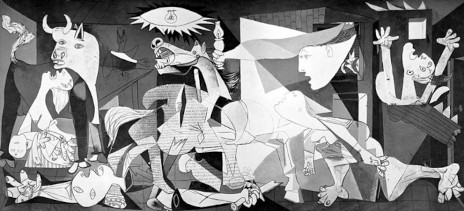
His most famous work is probably Guernica, inspired by the 1937 bombing of the town of Guernica during the Spanish Civil War.  The bombs, however, were from German planes.  Hitler, a supporter of Franco, had received permission to test new weapons in the area--Basque country, a Republican stronghold in the North.

This painting was Picasso's response:


What do you think?  Does it capture the chaos of a bombing, the emotions, or does the cubism distance the viewer?

Now for writing:  Do you know of any works that were a response to a highly specific event, such as Guernica?

Wednesday, April 17, 2013

A - Z Challenge: OLIVES

SPAIN

Again, I don't have a lot to post today.  Not only are these letters difficult, but I've been in Ireland since Friday, so I hurriedly wrote all these posts in advance.  I could give up, but no!  I've come this far, so I refuse to lose the challenge!  Muahaha!

So.  Olives.  Spain is a huge producer of olives.  If you drive through the countryside, you'll see rows and rows of olive trees.  So it's no surprise that olive oil is essential to the Spanish kitchen.  At restaurants, they're often served alongside the bread brought before the meal.

And that's all I have to say about them.  I like olives, but they're only so interesting :)

Tuesday, April 16, 2013

A - Z Challenge: NADA

N is for Nada, which in Spanish, means Nothing.

That's right.  I have nada to post today :)

But hey, I think that counts.  I haven't lost the challenge yet!

Saturday, April 13, 2013

A - Z Challenge: LEFTOVERS (ROME & MOORS)

SPAIN

The Iberian Peninsula has been inhabited for centuries, most notably by the Roman and Ottoman Empires.  To this day, you can see many leftovers in Spanish cities, especially in the autonomous community of Andalusia, the name of which comes from the Arabic Al-Andalus.

Architecture

This Roman aqueduct is right by my house!
Moors maintained a presence on the Iberian Peninsula from 711 to 1492.  That's 781 years.  Comparably, Spain has only been "Spanish" as we know it for 521 years, which is very strange to think about.  It's been asked if the Reconquista, or the Reconquest (when Catholics led by Ferdinand and Isabel expelled the Arabs from Spain), was actually a reconquest, or if it was just a conquest.

I believe these columns were supposedly
placed here by Hercules himself.  (Hercules
founded many cities in Spain, including
Sevilla and Barcelona, according to legend.)
Traveling through Spain, you'll find a lot of architectural leftovers from Rome and Moorish occupation.  In Sevilla, for example, there are several Roman columns.  My street even has the ruins of an old aqueduct :)

A patio in the Alcázar.  These archways are a
signature element of Islamic architecture.
As for Moorish influence, it's everywhere.  Courtyards, rounded archways, and tiles all have their origins in Arabic architecture.

The Alcázar, for example, was originally a Moorish fort, converted into a royal palace.  Though there are certain Gothic elements, most of it is Islamic design.

Sevilla's most famous site, the Cathedral, was actually originally a mosque.  The Giralda served as a minaret from which someone would issue the call to prayer.  It was converted into a Cathedral, yet it still has lots of Islamic architecture.


The Cathedral in Sevilla.


Language

While Spanish is a romance language that has Latin roots, its filled with words that come from Arabic.  Some of these include:

Andalucía - from Al-Andalus, the Arabic name for the region.
Ojalá - I hope, from law šhaʾ allāh "God willing".
Alcázar - palace, from al-qasr
Zumo - juice, from zum.  Spain is the only Spanish-speaking country that uses "zumo" for juice.

And hundreds more!

WRITING

When writers build worlds, they often draw from real cultures and civilizations.  Stereotypical fantasy worlds are usually based on medieval Northern Europe (the Holy Roman Empire is probably closest in comparison); and when they name characters and places, they often pick a language to act as the "root language."

Why is this a good idea?  So that the made-up words sound as though they belong to the same family, the same culture.  It helps to make the world believable, and that's extremely important :)  So as you create world, make like Spain and let other civilizations influence you!

P.S.  I'd love to read a fantasy in which the world is based on North Africa or Middle East, so if you know of any, please let me know!

Friday, April 12, 2013

A - Z Challenge: KISSING

SPAIN

Pucker up!  In Spain, as in many Hispanic countries, kisses are big.  That is, dos besos--or two kisses, one on each cheek--is Spain's form of a greeting.  While handshakes exist, they're exclusively between men, and even then they aren't that common.

Whenever you greet someone in Spain, whether you're best friends or you've never seen them before in your life, most likely you'll exchange besos.  You'll say something like, "Hola, me llamo Sam.  Mucho gusto" ("Hello, my name is Sam.  Nice to meet you"), then he'll introduce himself, and proceed to give you dos besos.  Sometimes the besos come even before the name.  However, most of the time lips don't actually touch skin; rather, it's cheek to cheek, like this:


Besos are something that, if you come to Spain, you must do.  Otherwise, you'll end up confusing a lot of people.  Plus, you'll likely insult them, and you don't want that.  So don't be shy!

WRITING

Who doesn't love a good kissing scene, right?  They're fun to read.  They're fun to write.  However, it's easy to go overboard:  a first kiss doesn't need to be a page long.  One sentence, maybe two, will suffice.  Much longer than that, and I start to roll my eyes, unless there's a specific reason it's being dragged out.

Kisses, especially in YA, are one of the weapons writers hold in their arsenals.  Even if the book isn't strictly romance, the question of "When will the characters admit their love and share a kiss?" keeps readers turning pages.  In the hopes that the next scene, the next chapter, will hold that long-awaited kiss.  That's why I'm so opposed to insta-love.  If the romance happens right away, the story can quickly lose a lot of momentum.

That's why Ron and Hermione's kiss is one of the best literary kisses of all time.  Because we had to wait.  And not just for a few chapters, but for seven.  whole.  books.  So when it finally happened, I was beside myself with joy, jumping up and down, shouting "Finally!" at the top of my lungs.
What do you think about kissing scenes?  What are your favorites?  Least favorites?

Thursday, April 11, 2013

A - Z Challenge: JUAN TENORIO (DON JUAN)

SPAIN

Most likely you've heard of the infamous Don Juan, but have you ever paused to ask yourself, "What, exactly, is his deal?"

I know I didn't.  Not until I came to Spain, anyway.  I knew that Don Juan was a notorious lover, but that's it.

There are various versions of the tale.  In general, however, it goes something like this:

Don Juan supposedly lived in Sevilla, specifically in Barrio Santa Cruz, where today there are plaques denoting his house and the house of one of his lovers, Doña Inés.  He was wealthy, handsome, prone to gambling and violence, and extremely proud of his prowess.

The plaque in Barrio Santa Cruz.  It reads something like:  "Popular rumor says that in this part of the old neighorhood, on Chorro Street, there was born a gentleman whom nobody could surpass in games, in fighting, or in love.  He died and was redeemed in Seville by Doña Inés, and the pen of Don José Zorrilla, in his retelling of the legend, gave him life in the universal work of DON JUAN TENORIO."
After seducing Don Inés, her father Don Gonzalo challenged him to a duel.  Don Juan, always the better fighter, won, but had to flee the city.  Shortly thereafter, Doña Inés died of sorrow.

Then Don Juan sees a vision of his own death.  His own burial.  Plot twist!  Don Juan was actually killed in the duel with Don Gonzalo, and here is where versions split:  sometimes, Doña Inés redeems him and together they go to Heaven.  In others, he is swept into Hell as punishment for his philandering, violence, and vanity.

WRITING

The Don Juan legend is one that gets a lot of retelling, at least in Spanish literature.  What with shows like Once Upon a Time, books like Cinder, and movies like Jack the Giant Slayer, retellings are big these days.  I really like retellings, especially when they involve more obscure legends, though my all-time favorite is Ever After.  Not exactly obscure, but how can you go wrong when the fairy godmother figure is Leonardo da Vinci?  Right now, I'm reading This Dark Endeavor and Such Wicked Intent, both retellings/prequels of/to Frankenstein, written by one of my favorite authors, Kenneth Oppel.  If you like retellings, I definitely recommend them.

What's your opinion on the retelling trend?  What are you favorites?  What would you like to see?

Wednesday, April 10, 2013

A - Z Challenge: INQUISITION

SPAIN

All right, I'm going to cheat on this post.  But I've already written (a lot) about the Spanish Inquisition, so if you're interested, go here:

Saturday, April 6, 2013

A - Z Challenge: FLAMENCO

SPAIN

For me, the best part about flamenco is it's authenticity.  Unlike the bullfights, it's not a spectacle put on to attract tourists.  No, flamenco is deeply entrenched in Spain's culture.  That means that most everyone, especially in Andalucía, can sing or dance flamenco, at least to a certain extent.  It's not exclusive to the professionals.  If you're in Spain long enough, chances are you'll come across someone singing flamenco at the top of his lungs as he walks down the street.

Flamenco dancers in Sevilla, Spain
Walking through Sevilla, you'll find dozens of dress shops.  These dresses are pricey.  The cheapest you'll find is 75 euro (about $100), and that's the absolute cheapest.  For many girls, they get a new dress every year, which they adorn with flowers and ribbons, and will don during the week of Feria, a celebration based on flamenco, which happens to begin two weeks from now.  All night the people of Sevilla gather in casetas, personal tents set up on designated fairgrounds, where they dance flamenco 'til dawn.  Not to impress anyone, but just for fun.  For tradition.

Feria in Sevilla.  This is in two weeks.
WRITING

Many Spanish romantic writers, such as Gustavo Adolfo Bécquer, incorporated flamenco into their writing.  They referred to is as the poesía popular, or the popular poetry, and drew on its themes and rhythms to compose short stories and poems that reflected Spanish pop culture.  To them, flamenco was a source of endless inspiration:  it embodied passion, beauty, and pain in its potent vocals and intense movements.

Here's a video of some flamenco:


Friday, April 5, 2013

A - Z Challenge: ECONOMIC CRISIS

Spain's economy is a wreck.

It has been for a few years now, and it doesn't look like it's getting better anytime soon.

What's interesting about the crisis is that it's very visible.  When I first came to Spain, the Copy Center at my university went on strike.  It didn't matter that classes were about to start and students needed their books.  They were making a statement, because thanks to the crisis, the workers hadn't been paid in over four months.

Mountain of garbage in Sevilla.
A few weeks later, many cities--including Seville, where I live--had a garbage strike.  That mean no garbage was collected for weeks.  Imagine, mountains of garbage piled up on the streets, which are fairly narrow, so there's no escape from the stench.  It was, as you'd expect, gross.  But hey, the workers hadn't been given a raise in over four years.

Then there are the protests.  Spain likes protests.  In fact, most of Europe likes protests.  If history is any indication, it seems the people get bored, so what do they do?  They start a revolution for kicks and giggles.  Last night I was talking to a Spaniard about the Infanta Cristina scandal, and you know what he said when I asked if he thinks the monarchy is in danger?  "Yeah, the people will probably want the monarchy to, well…to leave Spain."

Ready the pitchforks, folks.

Communist rally.
But seriously, it seems every few weeks I accidentally stumble upon a protest--and I mean a protest.  Hundreds of people, sometimes thousands, gathering in the main streets with banners.  All ages, too, not just rabblerousing youngsters.  Within a few days of coming here, I found myself walking past a communist rally.  A COMMUNIST rally!

Is this real life?

It was shocking to me.  Try that in the States, and you're on the CIA's watch list before you can say, "Workers of the world, unite!"

With such an economic crisis, unemployment rates are sky high at over 27%, compared the U.S.'s 7.7%.  For people under 25 (so right out of college), that rate is about 60%.  With rates like this, people take what they can.  When I asked a Spanish student what he wants to do after he graduates with a degree in computer technology, he shrugged.  "I just want a job.  I don't care what it is."

For more information on Spain's economic crisis, click here.


A protest on Día de Andalucía, a day during which residents of Andalusia are supposed to celebrate, not protest.  But they wanted to make a statement.

WRITING

Uh...Any ideas?

Thursday, April 4, 2013

A - Z Challenge: DALÍ


SPAIN
"I don't do drugs.  I am drugs." - Salvador Dalí


I love Dalí, but I'm not sure if I love his paintings, or if I just love him.  He's one of those figures who is so ridiculous, you just can't help but like him.  Also, his gravity-defying mustache makes him a winner.
After Pablo Picasso, Dalí is probably Spain's most famous artist, best known for his work The Persistence of Memory, often referred to as "that painting with the melting clocks."  There was a giant mural of it in my high school, so after seeing it every day, it's one of my favorite paintings.  Do I have any idea what it means?  Nope.  But the melting clocks are fascinating.

The Persistence of Memory, completed 1931
Dalí was a surrealist, so he was into abstract ideas and images that weren't grounded in the real world.  A few weeks ago, I was lucky enough to visit the Dalí museum in Barcelona, Spain, where I got to see (and even touch, when it came to sculptures) some of his lesser known works.


To the left, you'll see Automobile Giving Birth to a Blind Horse Biting a Telephone.  (Sorry for the poor quality photo, but photography isn't my strong point).  Not sure what it means, if it means anything at all, but I think the title is hilarious.  Also, very straightforward.
Look familiar?  Dalí had quite a few obsessions, or so I gathered from my visit to the museum:  horses, rhinoceroses, and melting clocks.  The melting clocks are definitely what interest me most.  Time melting away…Very cool.  Also, interesting tidbit:  the 20s (during which Dalí worked) marked the beginning of the world's obsession with time and prolonged youth (think works like Twilight Sleep or Tender is the Night).  It's when time phrases became an essential part of our vocabulary:  kill time, keep time, out of time, etc.  So I have to wonder if Dalí, who finished The Persistence of Memory in 1931, was commenting on this phenomenon.


He was also fascinated by horses, apparently.  An entire room of the museum was dedicated to his paintings and sculptures about horses, many of them from famous stories.  This painting features Don Quixote and Sancho Panza.


There was also a little hall dedicated rhinoceroses.  When I saw Midnight in Paris, I didn't realize that he was, actually, a little obsessed with rhinoceroses.  But alas, I was mistaken.  Enjoy this awesome scene from an awesome movie, featuring Adrien Brody as Salvador Dalí:


WRITING

Picture prompts?

One of Dalí's paintings would be awesome inspiration for a picture prompt.  I would love to read a story, or even a full length novel, based on The Persistence of Memory.  Even just a world based on it.  Who knows?  Maybe one day I'll try my hand at writing it.


Wednesday, April 3, 2013

A - Z Challenge: CORTÉS

SPAIN

So I love history, and especially Latin American history, so instead of talking about Catalonia or comida or las Carlistas or a million other topics that begin with C, I'm going to share a little bit about one of Spain's most famous historical figures, Hernán Cortés.

Assuming you've taken some sort of history class, you probably know Cortés as the conquistador behind the fall of the Aztec Empire in Mexico.  You might also know him as that guy from The Road to El Dorado (which is a great movie, by the way):


Right.  So a Spanish version of Johnny Bravo.  (Can you tell I'm a 90s kid?)

Anyway, history at its most basic will say that Cortés marched through Mexico to Tenochtitlan, the capital city of the Aztec Empire, and with only a few hundred men and some horses, took down thousands upon thousands of natives, largely due to the smallpox they brought with them.

But that's not what makes him interesting.  Conquests had been going on for centuries, and though it's interesting that the Aztecs might have believed him to be a god (though there's a lot of speculation about that), it's not what intrigues me.

Hernán Cortés
Nope, I'm fascinated by this little anecdote:

In 1518 the governor of Cuba, Diego Velázquez, sent Cortés on an expedition to conquer Mexico, but soon changed his mind, and revoked his permission.  Cortés ignored that, and when Velázquez arrived on the mainland in person to tell Cortés off, he replied with, "Sorry, gotta go," and quickly fled.  He then founded a town and made himself leader, which hypothetically excused him from being under the Governor of Cuba's authority.  Hypothetically.

Of course, some of his men had doubts.  Cortés didn't exactly have experience leading an army, and who was he to defy the governor of Cuba?  Cortés, sensing that many of his men wanted to desert, scuttled every ship except one, which he sent back to Spain, literally trapping everyone on mainland Mexico, with no choice but to proceed.

To me, this little anecdote is what makes him most interesting.  Are these admirable actions?  No, definitely not, especially considering that it led to the deaths of thousands of natives.  But it was ridiculously courageous--and certainly insane--to scuttle his own ships, stranding himself and some 600 men in a place that very few Europeans had ever visited.

Don't get me wrong:  by no means do I condone his actions.  In fact, he's ranked pretty darn high on my list of historical jerkwads.  But there's no denying that he was, well…a badass, at least in some respects.

Here in Spain, you'll find quite a few paintings and statues dedicated to him.  The General Archive of the Indies in Seville is filled with them.  It's definitely interesting, since in the U.S., his history is always tinted with negativity:  "Hernán Cortés, a bad guy."  Since being here, my opinions about that haven't changed--Cortés and the conquistadores brought a lot of misery--but it's strange to see memorials to them.  But it goes both ways:  Why is Andrew Jackson, the man behind the Trail of Tears, commemorated every time we pull out a twenty?

WRITING

There are two sides to every story.

America doesn't like Cortés.  To most, he's a mass murderer.  But to Spain he's technically a hero, even if nowadays a lot of Spaniards don't exactly approve of his actions.  His conquest of Mexico was the beginning of Spaniards taking over the rest of mainland Latin America, save Brazil.  Keep in mind that Spain only became one unified country in 1492, so how awesome must it have been for this brand new country to 1) "discover" the New World, and 2) exploit its resources until it was one of the richest nations around, which enabled it to have an armada to rival the British Navy.  In less than a century, it went from being a cluster of very divided kingdoms, largely controlled by North African Arabs, to the most powerful empire in the world.  An evil empire, according to the French and British, who felt both jealous and threatened.  C is for Competition, right?

Spains rise to power, which has a lot to do with Cortés, reminds us that there are two sides to every story.  A villain isn't a villain to everybody, and the same goes for heroes.  The best characters are those whose good/evil alignment isn't clear, and it all depends on your point of view.  The one that immediately comes to mind is Ben Linus from ABC's Lost.  Three years after the end of the show, I still have no idea whether to consider him a good guy or a bad guy.  ABC is doing it again with Once Upon a Time:  Where on the scale does Rumplestiltskin/Mr. Gold lie?  (Interestingly, these characters also tend to be the best actors).

Ben Linus, played by Michael Emerson, from ABC's LOST
How about Javert from Les Miserables?  He is the "bad guy" of the novel/musical/movie, but if you look at the story from his perspective, he's doing what society normally approves of:  attempting to stop a wanted thief.  If Les Miz were not fiction, but was a true story playing out in our own modern society, we would probably applaud Javert for seeking a potentially dangerous criminal.

"Of course not," you might say.  "Jean Valjean is a really good man."

"Yeah," I'd reply.  "But how often to you stop to chat with the criminal about his emotions, morals, dreams, family life, etc?  You don't."

But because Les Miz gives us Jean Valjean's PoV, we view him as the hero, while Javert is stuck being the villain.

So keep that in mind when writing!  To some, your bad guys might not actually be bad guys--and those kinds of characters tend to be the most interesting.

Tuesday, April 2, 2013

A - Z Challenge: BULLFIGHTING

SPAIN

When you think Spain, chances are you think bullfighting, though it's also practiced in other parts of Europe and Latin America.  At its most basic, the "art" consists of baiting a bull, then killing it in the arena, known as a bullring.
Bull statue in Ronda.
Believe it or not, bullfighting is considered an art, not a sport.  The matadors, locally referred to as toreros, train from an early age, developing their own rhythm and style, for which they're known around the country, and sometimes the world.  As Hemingway wrote, "Bullfighting is the only art in which the artist is in danger of death and in which the degree of brilliance in the performance is left to the fighter's honour."

Bullring in Ronda.
It's a practice that dates back thousands of years (pre-Rome), but it's often compared to the more well-known gladiatorial competitions.  However, modern bullfighting, which involves fighting on foot (rather than mounted on a horse), staying within inches of the bull, and using the red cape, came about in the 18th century.

Nowadays there's a lot of controversy about bullfighting.  My host mother, Isabel, is very against it, for example.  When I asked her about it, she threw up her hands and said, "¡Qué barbaridad!"  The autonomous community of Catalonia (where Barcelona is located) actually banned bullfighting, and animal rights activists are trying to get the rest of Spain to follow suit.

Honestly, it seems that nowadays bullfighting is more for tourists than for Spaniards.  People come from all over the world and pay darn good dinero to see it.  Don't get me wrong:  there are indeed Spaniards who are bullfighting fanatics (the kind who get season tickets), but not nearly as many as there used to be.  But Spain is all about cultural tradition, so I highly doubt it's going to get the boot.

WRITING

Confession:  Hemingway is a historical crush
of mine.  For his writing, for his adventurous
spirit, for his love of Spain.  (All right, his looks,
too).
You know who liked bullfights?  Ernest Hemingway, whose novel The Sun Also Rises is all about bullfights in Pamplona, complete with a twisted love triangle (rectangle?  pentagon?) involving a matador.  He goes into great detail describing the bulls, the bullfights, and the style of Pedro Romero, the matador remembered for his ridiculously tight pants.  (Though really all matadors have tight pants, but his are notable since they help to contrast him with protagonist Jake Barnes.  If you have no idea what I'm talking about, you can read all about it here--or better yet, read the book because it's great).

In both Hemingway's The Sun Also Rises and Esteban Echeverrías The Slaughterhouse (El Matadero, in Spanish), bulls are stand-ins for the human characters.  Symbols, if you will, usually of immense honor and courage.

Symbols are always fun to write.  They're like secret codes:  you know them, and your readers have to figure them out.  Though since I don't generally write literary fiction, most of the time I don't realize I included a symbol until I go back and revise.  Then I'm like, "Hey.  That works.  Good job, subconscious."

What's your opinion on bullfighting?  Approve or disapprove? Have you seen a bullfight?  Read The Sun Also Rises?  Thoughts on symbols?

And because I can, how about a Spanish song?  B is for "Bulería," by David Bisbal, who happens to have very bouncy hair :)  There may or may not be a bullring in this video.