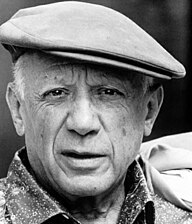
Pablo Picasso is one of the most famous artists of all time, and he's definitely the best-known cubist. He was born in Málaga, a city in Andalucía, in 1881, though he spent much of his life in France (like Dalí, he makes an appearance in one of my favorite movies, Midnight in Paris).
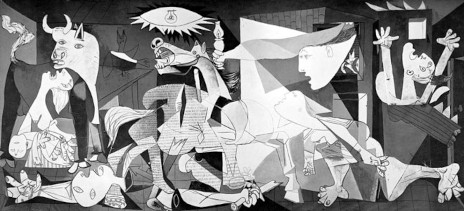
His most famous work is probably Guernica, inspired by the 1937 bombing of the town of Guernica during the Spanish Civil War. The bombs, however, were from German planes. Hitler, a supporter of Franco, had received permission to test new weapons in the area--Basque country, a Republican stronghold in the North.
This painting was Picasso's response:
What do you think? Does it capture the chaos of a bombing, the emotions, or does the cubism distance the viewer?
Now for writing: Do you know of any works that were a response to a highly specific event, such as Guernica?
I love Dalí, but I'm not sure if I love his paintings, or if I just love him. He's one of those figures who is so ridiculous, you just can't help but like him. Also, his gravity-defying mustache makes him a winner.
After Pablo Picasso, Dalí is probably Spain's most famous artist, best known for his work The Persistence of Memory, often referred to as "that painting with the melting clocks." There was a giant mural of it in my high school, so after seeing it every day, it's one of my favorite paintings. Do I have any idea what it means? Nope. But the melting clocks are fascinating.
The Persistence of Memory, completed 1931
Dalí was a surrealist, so he was into abstract ideas and images that weren't grounded in the real world. A few weeks ago, I was lucky enough to visit the Dalí museum in Barcelona, Spain, where I got to see (and even touch, when it came to sculptures) some of his lesser known works.
To the left, you'll see Automobile Giving Birth to a Blind Horse Biting a Telephone. (Sorry for the poor quality photo, but photography isn't my strong point). Not sure what it means, if it means anything at all, but I think the title is hilarious. Also, very straightforward.
Look familiar? Dalí had quite a few obsessions, or so I gathered from my visit to the museum: horses, rhinoceroses, and melting clocks. The melting clocks are definitely what interest me most. Time melting away…Very cool. Also, interesting tidbit: the 20s (during which Dalí worked) marked the beginning of the world's obsession with time and prolonged youth (think works like Twilight Sleep or Tender is the Night). It's when time phrases became an essential part of our vocabulary: kill time, keep time, out of time, etc. So I have to wonder if Dalí, who finished ThePersistence of Memory in 1931, was commenting on this phenomenon.
He was also fascinated by horses, apparently. An entire room of the museum was dedicated to his paintings and sculptures about horses, many of them from famous stories. This painting features Don Quixote and Sancho Panza.
There was also a little hall dedicated rhinoceroses. When I saw Midnight in Paris, I didn't realize that he was, actually, a little obsessed with rhinoceroses. But alas, I was mistaken. Enjoy this awesome scene from an awesome movie, featuring Adrien Brody as Salvador Dalí:
WRITING
Picture prompts?
One of Dalí's paintings would be awesome inspiration for a picture prompt. I would love to read a story, or even a full length novel, based on The Persistence of Memory. Even just a world based on it. Who knows? Maybe one day I'll try my hand at writing it.
When you think Spain, chances are you think bullfighting, though it's also practiced in other parts of Europe and Latin America. At its most basic, the "art" consists of baiting a bull, then killing it in the arena, known as a bullring.
Bull statue in Ronda.
Believe it or not, bullfighting is considered an art, not a sport. The matadors, locally referred to as toreros, train from an early age, developing their own rhythm and style, for which they're known around the country, and sometimes the world. As Hemingway wrote, "Bullfighting is the only art in which the artist is in danger of death and in which the degree of brilliance in the performance is left to the fighter's honour."
Bullring in Ronda.
It's a practice that dates back thousands of years (pre-Rome), but it's often compared to the more well-known gladiatorial competitions. However, modern bullfighting, which involves fighting on foot (rather than mounted on a horse), staying within inches of the bull, and using the red cape, came about in the 18th century.
Nowadays there's a lot of controversy about bullfighting. My host mother, Isabel, is very against it, for example. When I asked her about it, she threw up her hands and said, "¡Qué barbaridad!" The autonomous community of Catalonia (where Barcelona is located) actually banned bullfighting, and animal rights activists are trying to get the rest of Spain to follow suit.
Honestly, it seems that nowadays bullfighting is more for tourists than for Spaniards. People come from all over the world and pay darn good dinero to see it. Don't get me wrong: there are indeed Spaniards who are bullfighting fanatics (the kind who get season tickets), but not nearly as many as there used to be. But Spain is all about cultural tradition, so I highly doubt it's going to get the boot.
WRITING
Confession: Hemingway is a historical crush of mine. For his writing, for his adventurous spirit, for his love of Spain. (All right, his looks, too).
You know who liked bullfights? Ernest Hemingway, whose novel The Sun Also Rises is all about bullfights in Pamplona, complete with a twisted love triangle (rectangle? pentagon?) involving a matador. He goes into great detail describing the bulls, the bullfights, and the style of Pedro Romero, the matador remembered for his ridiculously tight pants. (Though really all matadors have tight pants, but his are notable since they help to contrast him with protagonist Jake Barnes. If you have no idea what I'm talking about, you can read all about it here--or better yet, read the book because it's great).
In both Hemingway's The Sun Also Rises and Esteban Echeverrías The Slaughterhouse (El Matadero, in Spanish), bulls are stand-ins for the human characters. Symbols, if you will, usually of immense honor and courage.
Symbols are always fun to write. They're like secret codes: you know them, and your readers have to figure them out. Though since I don't generally write literary fiction, most of the time I don't realize I included a symbol until I go back and revise. Then I'm like, "Hey. That works. Good job, subconscious."
What's your opinion on bullfighting? Approve or disapprove? Have you seen a bullfight? Read The Sun Also Rises? Thoughts on symbols?
And because I can, how about a Spanish song? B is for "Bulería," by David Bisbal, who happens to have very bouncy hair :) There may or may not be a bullring in this video.
Ladies and gents, I give you my new catchphrase: "arte como arma," or in English, "art as a weapon". If you're wondering why it's in Spanish, it's because I first read it in Spanish. No, unfortunately I can't take credit for it :(
I'm enrolled in a course at my university called "Seville and the Community." Essentially, it's a class about social and political issues in Spain: homelessness, poverty, poor education, etc. This week I gave a fifteen-minute oral presentation on "arte como arma," and in the middle of my powerpoint, realized, "Hey, this isn't just for a grade. I actually have something interesting to say about this."
Before I begin, what exactly do I mean by art? Well, everything: painting, sculpture, drawing, carpentry, fashion, music, dance, poetry, prose…
My basic argument: art is great for recreation, but it can also be used as a weapon against hardship, whether that hardship is poverty, depression, social exclusion, unemployment, etc. Of course, it isn't going to do away with these issues:
Art is a spiritual expression, an activity that generates joy, entertainment, and knowledge. A poem, a song, a play, surely cannot change reality or defeat misery, but it can act as a tool through which people can express their experiences, their stories, and aspire to better lives. This is what's called social art. - La Gaceta[translated from Spanish]
OK, social art. Basically, it's a way to cope with suffering: through self expression. However, I'm not sure if I completely agree with the above quote. Is it true that art cannot change reality or defeat misery?
I asked this question during my presentation and it generated a little bit of debate. Most people argued that art itself cannot change reality, but it can inspire people to change reality.
Well, of course. If people start munching on oil paintings in an attempt to end hunger, then we have a bigger problem than we thought.
I asked for some examples of art that has changed reality. Unfortunately, we were a little short in this area, so maybe La Gaceta has a point. But how about Uncle Tom's Cabin, which changed the United States' view on slavery leading up to the Civil War?
Whether art changes reality or not, it's still a way to lessen the pain of hardship:
Art is a solution. It's a sign of culture, and culture is what gives comfort in the face of the certainty of chaos and the forcefulness of the horrors that have been occurring for a long time. Culture is an analgesic, not an anesthetic. Culture is what provides serenity in the face of disaster. - Laura Fleischer, El arte como herramienta de intervención social[translated from Spanish]
So, culture to cope with disaster. Sounds about right. We were able to come up with more examples for this, like:
The Golden Age of Hollywood - The Golden Age of Hollywood began in the late 1920s, around the same time as the Great Depression. Though people struggled to put bread on the table, they didn't often begrudge a trip to the movies. The escapist films of the 1930s offered comfort to a society in crisis.
"A Modest Proposal" - Jonathan Swift's satiric essay deals with poverty and famine in Ireland during the early eighteenth century (the potato famine came later). He uses grotesque humor to point out society's problems, and if there's any one way to cope with hardship, it's humor. If you're interested, you can read the whole text here.
Guernica - Arguably Pablo Picasso's most famous painting, Guernica came as a result of a bombing during the Spanish Civil War. It was put on display at the 1937 World's Fair, thereby bringing the War international attention.
Slave culture - Slaves in the Americas used song and dance, usually with African or Native American influences, to help cope with the hardships of slavery and preserve their own cultural identity.
Guernica, by Pablo Picasso
But it's not just that art provides a coping mechanism; rather, there are tangible results, believe it or not. A twelve-year national study showed that underprivileged students who are involved in the arts generally have a higher success rates: they achieve more after high school graduation, they do more volunteer work, and they participate in politics.
So why did I choose this topic? And now, it's not because, as a writer, I strongly believe in the power of words (though that's true, too).
It's because of Polígono Sur, the neighborhood in which I teach English. Essentially, Polígono Sur is a chabolismo, or as we would call it, a slum. As one of the poorest areas in Sevilla, it has a reputation for crime, a reputation that's only augmented by its large gypsy population.
This fence in Polígono Sur is very close to my English class.
But damn, does Polígono Sur have art!
I'm talking flamenco. Not touristy flamenco, either, with the main goal being to entertain. No, this isn't some sort of spectacle. It's intensely personal, an expression of human emotions through music and dance; yet at the same time, it's communal. It brings people together, and as long as the flamenco lasts, those people are one cohesive group. They celebrate together, struggle together, survive together.
It's how they cope with poverty. With drug abuse. With the stigma associated with their community and their culture, especially if they're gypsies. By pouring their emotions into flamenco.
If you're interested in seeing flamenco in Polígono Sur, you can check out this documentary. Even if you don't know a lick of Spanish, you'll be able to see what I'm talking about within the first ten minutes:
Now to wrap up, I'll leave you with one of my favorite quotes:
We don't read and write poetry because it's cute. We read and write poetry because we are members of the human race. And the human race is filled with passion. And medicine, law, business, engineering…These are noble pursuits and necessary to sustain life. But poetry, beauty, romance, love…These are what we stay alive for. - Dead Poet's Society
What do you think? Can art be used as a weapon against hardship? Can art change reality? Can you think of any examples in which art has changed reality? How about when culture has helped cope with disaster?