Showing posts with label Ronda. Show all posts

Tuesday, April 2, 2013

A - Z Challenge: BULLFIGHTING

SPAIN

When you think Spain, chances are you think bullfighting, though it's also practiced in other parts of Europe and Latin America.  At its most basic, the "art" consists of baiting a bull, then killing it in the arena, known as a bullring.
Bull statue in Ronda.
Believe it or not, bullfighting is considered an art, not a sport.  The matadors, locally referred to as toreros, train from an early age, developing their own rhythm and style, for which they're known around the country, and sometimes the world.  As Hemingway wrote, "Bullfighting is the only art in which the artist is in danger of death and in which the degree of brilliance in the performance is left to the fighter's honour."

Bullring in Ronda.
It's a practice that dates back thousands of years (pre-Rome), but it's often compared to the more well-known gladiatorial competitions.  However, modern bullfighting, which involves fighting on foot (rather than mounted on a horse), staying within inches of the bull, and using the red cape, came about in the 18th century.

Nowadays there's a lot of controversy about bullfighting.  My host mother, Isabel, is very against it, for example.  When I asked her about it, she threw up her hands and said, "¡Qué barbaridad!"  The autonomous community of Catalonia (where Barcelona is located) actually banned bullfighting, and animal rights activists are trying to get the rest of Spain to follow suit.

Honestly, it seems that nowadays bullfighting is more for tourists than for Spaniards.  People come from all over the world and pay darn good dinero to see it.  Don't get me wrong:  there are indeed Spaniards who are bullfighting fanatics (the kind who get season tickets), but not nearly as many as there used to be.  But Spain is all about cultural tradition, so I highly doubt it's going to get the boot.

WRITING

Confession:  Hemingway is a historical crush
of mine.  For his writing, for his adventurous
spirit, for his love of Spain.  (All right, his looks,
too).
You know who liked bullfights?  Ernest Hemingway, whose novel The Sun Also Rises is all about bullfights in Pamplona, complete with a twisted love triangle (rectangle?  pentagon?) involving a matador.  He goes into great detail describing the bulls, the bullfights, and the style of Pedro Romero, the matador remembered for his ridiculously tight pants.  (Though really all matadors have tight pants, but his are notable since they help to contrast him with protagonist Jake Barnes.  If you have no idea what I'm talking about, you can read all about it here--or better yet, read the book because it's great).

In both Hemingway's The Sun Also Rises and Esteban Echeverrías The Slaughterhouse (El Matadero, in Spanish), bulls are stand-ins for the human characters.  Symbols, if you will, usually of immense honor and courage.

Symbols are always fun to write.  They're like secret codes:  you know them, and your readers have to figure them out.  Though since I don't generally write literary fiction, most of the time I don't realize I included a symbol until I go back and revise.  Then I'm like, "Hey.  That works.  Good job, subconscious."

What's your opinion on bullfighting?  Approve or disapprove? Have you seen a bullfight?  Read The Sun Also Rises?  Thoughts on symbols?

And because I can, how about a Spanish song?  B is for "Bulería," by David Bisbal, who happens to have very bouncy hair :)  There may or may not be a bullring in this video.


Monday, April 1, 2013

A - Z Challenge: ANDALUCÍA

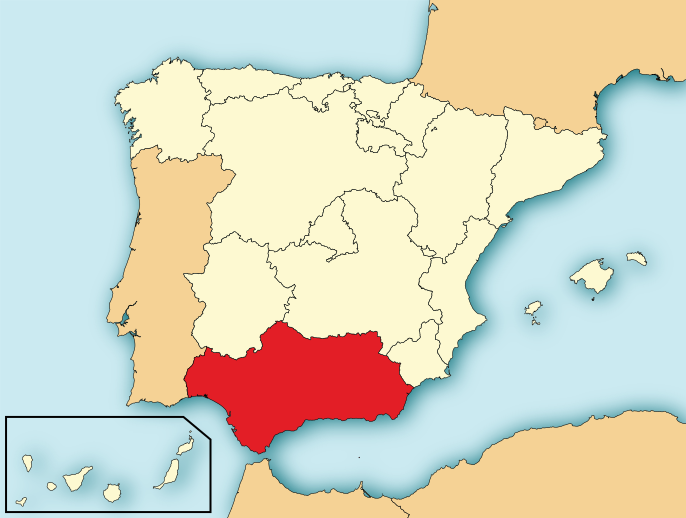
Andalusia in red.
Spain

Like most countries, Spain is far from uniform.  Rather, it is divided into seventeen different autonomous communities (and two independent cities located in North Africa), which work kind of like states.  (Though it's a little more complicated than that; these communities don't have as much independence as U.S. states).  Many of these autonomies used to be kingdoms before Spain became a unified nation in 1492.

I'm staying in the community of Andalusia (spelled Andalucía in Spanish), in southern Spain, the capital of which is beautiful Seville (where I live).

So what makes Andalusia unique?  Well, a lot.  I'm just going to cover the basics because otherwise, we'd get into novel territory, as far as length goes.
Seville's bullfighting stadium.  Yes, it's still in action.

When you think stereotypical Spain, you think Andalusia, whether you realize it or not.  Here is where you'll come across flamenco, bullfighting, and typical Spanish architecture.  It's also a place of immense historical importance, where you'll find:

  • Archivo de Indias - the home of the paperwork regarding the conquest of the Americas.  It's lined with images and sculptures of conquistador Hernán Cortés.
  • Cádiz - where revolutionaries wrote the Constitution of 1812, the first Spanish constitution.
  • Ronda - Hemingway set part of his Spanish Civil War novel For Whom the Bell Tolls in this city.
  • Granada - The last city to expel the Moors from Spain in 1492 during the Reconquista.  For this reason, a symbol of Ferdinand and Isabella is the granada, or the pomegranate.

The Andalusian countryside viewed from Ronda.

Writing

For those of you who don't know, my blog is mostly about finding inspiration in real life, then applying that inspiration to my fantasy world.  That is, my writing.  In a way, living in Andalusia has been one big research project.  Mostly, in terms of setting.

I'm a sucker for cool settings.  Though, I admit, I've set many a story in places like New York, Washington, D.C., and London, I much prefer more exotic places (usually within the real world).  I'd love to see more books set in Eastern Europe, North Africa and the Middle East, and especially Latin America.

Spain is a cool setting (at least in my opinion).  It's warm, it's colorful, and it has a very distinct culture that screams "¡VIVA ESPAÑA!"  But as far as books in English go, it generally takes a backseat to the U.S., U.K., France, Australia, and many other countries.  Which is actually kind of sad, considering it's the birthplace of the novel as we know it today.  Unfortunately, we English-speakers tend to forget that.
A courtyard in the Alcazar, a palace in Seville.

So for your next project, consider setting it in Spain.  If you're not sure about setting, ask yourself how important the setting is:  Does it make a difference if it's set in L.A. or Barcelona?  If your character is American or Spanish?  Obviously, it does, but that difference could be what makes your story stand out in the slushpile.  Personally, if I were an agent looking at two similar urban fantasies, both with strong characters and plots, and one was set in New York and the other in Seville, I'd choose the one in Seville, just because it's unique.  (Though I'm not an agent, so what do I know?)

Andalusia would also be a great place from which to draw inspiration for high fantasy.  Unfortunately, high fantasy is usually pretty predictable when it comes to setting.  Most of the time it's based on medieval Northern Europe, so the kingdoms that made up what is now France, Germany, and the U.K.  Stone castles, fairytale-esque villages, dense evergreen forests.

Andalusia also has castles.  Andalusia also has villages.  Andalusia also has forests--and mountains, and deserts, and beaches, and cliffs.

Only it's castles are often inspired by Islamic architecture, like the Alcazar in Seville.  Those villages, like Ronda, are sometimes situated hundreds of meters high.  And while you'll find "regular" forests, you'll also come across a ton of palm trees and oranges.  So why not pick the former kingdom of Al-Andalus as the basis for a fantasy world?  Star Wars did it.  The Plaza de España in Seville was used for scenes shot on the planet Naboo.


The list goes on.  Long story short, Andalusia is important to Spanish history and culture, despite being primarily an agricultural autonomy.  It's significantly less industrial than the rest of Spain.  Rather than huge metropolises, you'll find a sprawling countryside adorned with sunflowers, oats, barley, wheat, olives, and especially oranges.  In fact, orange trees line the streets of many Andalusian cities, including Seville
.
The Plaza de España, which was featured in Star Wars:  Episode I.

Sunday, March 3, 2013

Facing Fears

I can't say that I've craved adventure all my life.  In fact, I was a pretty skittish kid:  timid and shy, afraid of everything from vampires to mushrooms.  Yup, if there was a mushroom growing in my backyard, I wouldn't go outside.  It was that bad.

I've come a long way since then.

I'm not sure when all that passed, though I guess it wasn't until high school that I started to really thirst for adventure.  For danger.  For a story like the the ones I read about in my books.

That's one of the reasons I'm abroad.  Though I started having adventures the moment I stepped foot in Madrid ("Sorry, miss, but you can't get on this plane"), my first adventure à la Indiana Jones happened last weekend:

Signs to Inspire Fear #1

Ronda:  Acrophobia

One misplaced step, and I'm dead.

That's the thought that rung in my ears last weekend.  Well, not really.  Thinking back, that's probably what I should have thought.  Maybe it skittered through my mind once or twice, but the adrenaline kept pushing it away.

We were in Ronda, a city in the clouds, most famous for the bridge that spans the Tajo Canyon.  It also hosts Spain's oldest bullfighting arena and served as a vacation spot for Ernest Hemingway.  In fact, part of Hemingway's For Whom the Bell Tolls takes place in Ronda.  If you've read it, then you know the scene in which the Fascist sympathizers are thrown off a cliff?  Yup, that's Ronda.

You see that path?  Yeah, that's it.

You see, falling off a cliff is a very real possibility in Ronda.  Even more so once you start meandering down the shoddy donkey path that leads to the bottom of the canyon.  Parts of it are wide and well-kept, but others…Well, just don't lose your balance.

If you have any sense of adventure, you can't not go down this path.  Here is where the view is best:  to your right you have the bridge, which spans a magnificent waterfall; to your left, a beautiful countryside that stretches toward breathtaking mountains.  And surprisingly, the view doesn't get any worse as you make your way to the bottom; rather, the canyon walls loom all around you, making the bridge seem even more impressive.

Our view while eating lunch on a ledge.
If you're feeling especially adventurous, you can enter an old cave that supposedly used to serve as a hide-out for bandits.  There are also a few ladders you can climb and old buildings to explore, if you're so inclined.


Gibraltar:  Monkey-phobia

Apparently, Gibraltar is native for great.  Big.  ROCK.  (Name that reference?  The Road to El Dorado.  Yeah, I'm cool.  Get over it.)

But actually, Gibraltar really is a great big rock.  It's just a rock that happens to be an entire British colony.
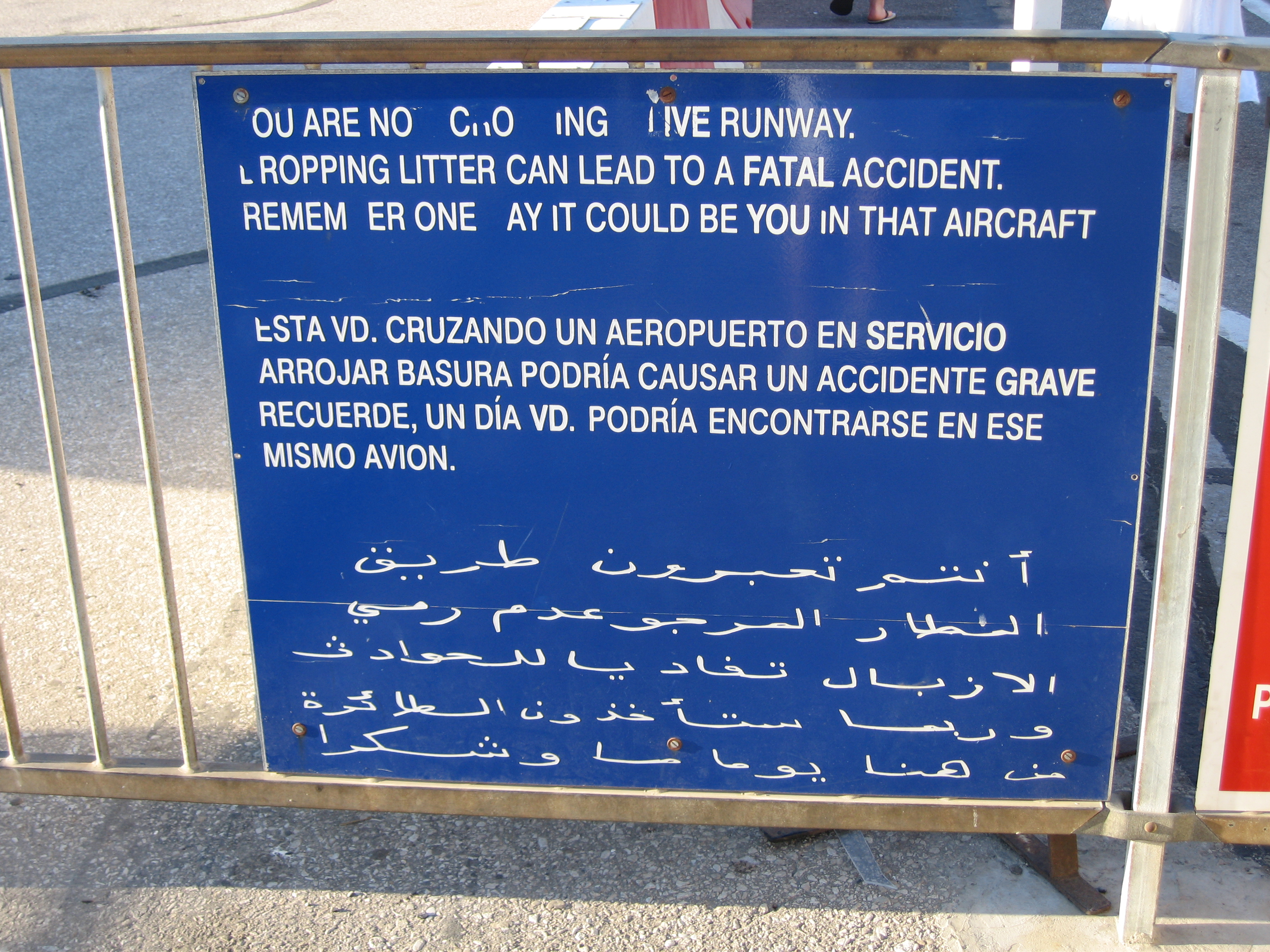
Signs to inspire fear #2
"You are crossing an active runway.  Dropping Litter can lead
to a fatal accident.  Remember one day it could be you in that
aircraft."
That's right.  Gibraltar is part of the U.K., so for a few hours we left tapas and siestas behind in exchange for tea and biscuits, fish and chips, and bright red telephone booths!

The adventure begins as soon as you cross the border.  To get from passport control to the actual city, you have to walk across an active airfield.  Don't get hit by a plane!

After that, we clambered through an old tunnel, probably once part of a fortress, that dumped us right into the city.  Unfortunately, we didn't have a lot of time, so we took the obligatory tourist photos and then hurried off to the cable car that would take us to the top of the rock.

Oh yes, the cable car.  On a scale of 1 to Sketchy, this cable car seemed pretty darn sketchy.  But we didn't have enough time to walk up, so in we went.

If you're afraid of heights, Gibraltar is not for you.

The cable car dumped us at the top of the rock.  Greeting us with greedy hands were…

Signs to Inspire Fear #3
Monkeys.  Macaques, to be specific.

I've never been a fan of monkeys, but I decided right then and there that I really don't like them.  They're pickpockets and identity thieves, and if you don't give them what they want, they'll rip your face off.

A minute after we stepped off the cable car we witnessed a showdown between a grown man and a monkey over the man's backpack.  The monkey eventually threw in the towel, but then he came after us.

Uh uh.  I don't think so, Monkey.  Try to steal my wallet, and I will pick you up and throw you off the cliff.

There were monkeys everywhere.  Sitting on the walls.  Riding on the tops of cars.  Climbing on people.  As my roommate would say, "I ain't about that life."

But there was no escape.  They were everywhere, which meant I had to face them.

Walking along the path down the mountain was like walking through a haunted house.  You know the ones in which people jump out at you?  Yeah, just like that.  With every step, I had to worry that a monkey would launch itself at me.

Don't be fooled.  These things are evil.  (This is a little one.)
But it's one of those things that I had to do.  Was I afraid?  Sure, but I didn't cower behind my friends, either.  In fact, there were points when I led the way.  That didn't mean I was any less afraid; rather, I knew that I had to do this if I wanted to get back down the rock.

At one point, our friend was attacked.  She pulled out a muffin, and bam!  A giant monkey appeared out of nowhere and threw itself at her.  She tossed the muffin as he climbed up her body; he went after it, and we hurried away, only to mount the Platform of Doom.

Imagine boat dock that juts straight out of the side of a mountain.  Or a giant diving board.  This was the midway station to catch the cable car.  Yes, there were railings, but the platform below was made up rickety wooden planks that rattled as the cable car approached.  I'm not afraid of heights, but my stomach twisted into knots as we waited.
Looking up from the Platform of Doom.

Now for writing.

We want our characters to be brave.  It's one of those traits that's usually required of a protagonist; otherwise, he'd never do anything, and there wouldn't be a story.

However, everyone is afraid of something.  Turns out I'm afraid of monkeys.  Some people fear  heights.  For others, its spiders that give them the heeby-jeebies.

Then there's the basic fear of failure that drives most plots.  In order to build tension, every MC has to have this fear to some extent, even if she won't admit it out loud.  But in my opinion, the best books add a few more fears, which hopefully contribute to the plot:

Just one of the many many reasons Harry Potter is so fantastic is that the main characters are brave Gryffindors, but they also all have personal fears:  Harry's fear of dementors is fantastic because he recognizes that he's afraid and seeks out a way to conquer that fear.  There are a lot of reasons my favorite Harry Potter book is Prizoner of Azkaban, but one of them is the boggart, the creature that shapeshifts into your worst fear and can only be defeated by laughter.  (You don't need me to tell you that J.K. Rowling is absolutely brilliant, but she's spot on when she says that laughter is the best way to combat fear.  Sure, I was terrified of those monkeys, but I kept my fear at bay by imagining the monkey stealing my bag, which contained my passport and credit cards, and then causing mischief all over the world, using my name to do so.)

Honestly I think fear is one of the hardest feelings to write.  At least, for me.  It's one of those emotions that's as easy to overdo as it is to leave out completely, and finding the correct balance sometimes seems impossible.

But I'm a writer, and writers are a little crazy obsessive.  They think about writing all the time.  Which is why I like to put myself in situations that scare me, whether its peering off the side of a cliff or passing through a wild monkey den:  "Hey, I'm absolutely terrified right now.  How does it feel?  I can totally write about this later."


That's as close as I was getting.  This is my face of utter distress.
Have you had any adventures à la Indiana Jones?  What would your boggart turn into?  Do you ever put yourself in unpleasant situations just so you can write about them later?